

Many households are accustomed to reusing vegetable oils for frying to ensure cost effectiveness’. In Malaysia, the most commonly used vegetable oils are paim and soybean oil’. However, reheating vegetable oil at high temperature leads to the production of rancid odour and flavour due to oxidation. Hyproperoxides and aldehydes are formed, and are absorbed by food and eventually enter our body after ingestion. These have been indicated as potentially harmful components in our diets.
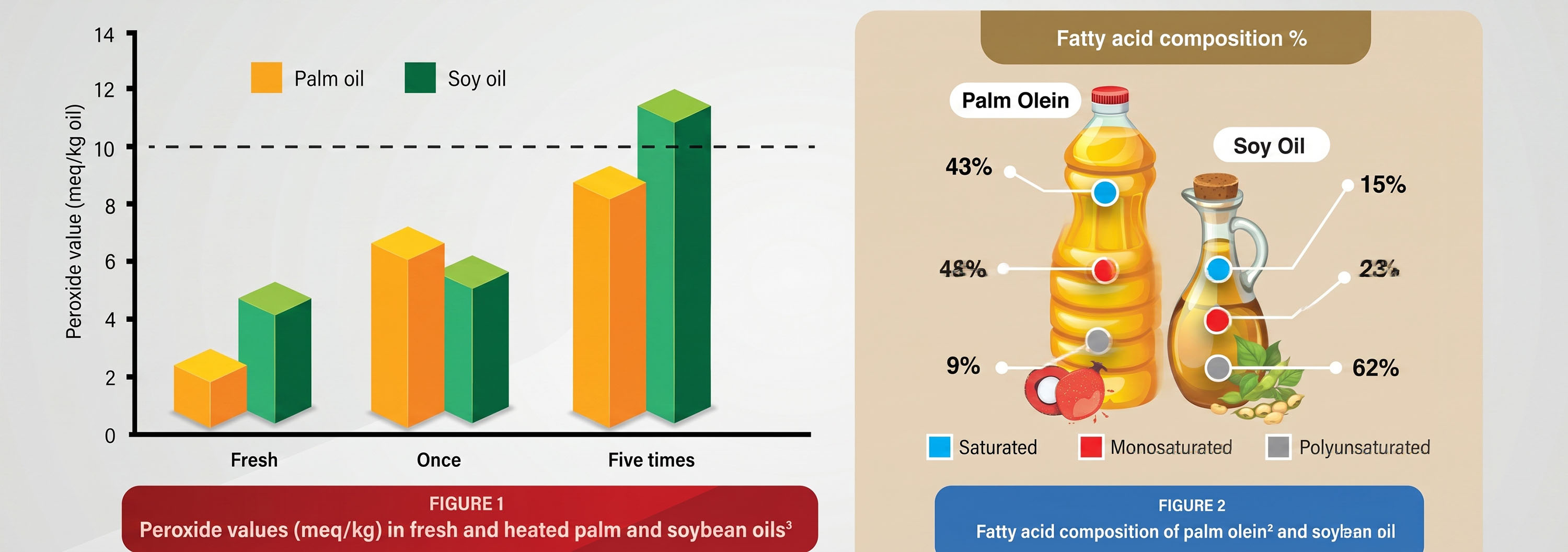
According to the American Oil Chemists’ Society (AOCS)’, the maximum allowable peroxide value for edible oils is 10 meq/kg oil. A study (Figure 1) showed that palm oil after heating five times had a peroxide value of 8 meq/kg oil, which was lower than the threshold set by AOCS, unlike soybean oil, which was at 11 meq/kg oil. Higher peroxide value indicates lower stability of the oil during trying. This clearly shows that palm oil is more stable than soybean oil. This is further facilitated by the fact that soybean oil had much higher percentage of polyunsaturated fatty acids (PUFA) which are prone to exidation. This indicates lower stability as PUFA contain oxidizable double bonds, among its composition.
Peroxide value indicates the presence of lipid hydroperoxides which in the gastric lumen, can decompose into free radicals that can oxidize other unsaturated fatty acids and form aldehydes that are potentially toxic to one’s healths.
Fortunately, antioxidants in vegetable oif provide natural resistance to oxidation’. Tocotrienols, which are abundantly found in palm oil, was found to estabit higher antioxidant ability than tocopherel?, which is found in other oils such as soybean oil. Based on these observations. In this comparison, palm oil emerges as the more stable oil for repeated frying with less potential to produce harmful or toxic components.