


| Country : China | ||||||||||||
|---|---|---|---|---|---|---|---|---|---|---|---|---|
| Oils and Fats Ending Stocks | ||||||||||||
| Palm Oil (MT) | Soybean Oil (MT) | Sunflower Oil (MT) | Rapeseed Oil (MT) | Other Oils (MT) | Total Ending Stocks (MT) | |||||||
| 2026 | 2025 | 2026 | 2025 | 2026 | 2025 | 2026 | 2025 | 2026 | 2024 | 2026 | 2025 | |
| January | 709,200 | 418,900 | 883,300 | 757,300 | - | - | 242,000 | 551,000 | - | - | 1,834,500 | 1,727,200 |
| February | 799,400 | 356,000 | 855,300 | 816,200 | - | - | 271,000 | 683,500 | - | - | 1,925,700 | 1,855,700 |
| March | 826,100 | 322,500 | 811,500 | 740,200 | - | - | 302,000 | 791,500 | - | - | 1,939,600 | 1,854,200 |
| April | 696,000 | 343,000 | 739,500 | 579,600 | - | - | 355,000 | 814,000 | - | - | 1,790,500 | 1,736,600 |
| May | 762,500 | 330,400 | 818,300 | 689,900 | - | - | 363,000 | 781,500 | - | - | 1,943,800 | 1,801,800 |
| June | 724,100 | 463,800 | 1,012,100 | 837,900 | - | - | 412,000 | 747,000 | - | - | 2,148,200 | 2,048,700 |
| July | 803,000 | 585,500 | 1,143,700 | 989,300 | - | - | 372,000 | 673,000 | - | - | 2,318,700 | 2,247,800 |
| August | 873,700 | 591,200 | 1,228,000 | 1,146,600 | - | - | 414,000 | 664,000 | - | - | 2,515,700 | 2,401,800 |
| September | 543,100 | 1,178,300 | - | - | 583,000 | - | - | 2,304,400 | ||||
| October | 561,800 | 1,149,200 | - | - | 514,000 | - | - | 2,225,000 | ||||
| November | 643,000 | 1,123,300 | - | - | 368,000 | - | - | 2,134,300 | ||||
| December | 704,300 | 988,100 | - | - | 291,000 | - | - | 1,983,400 | ||||
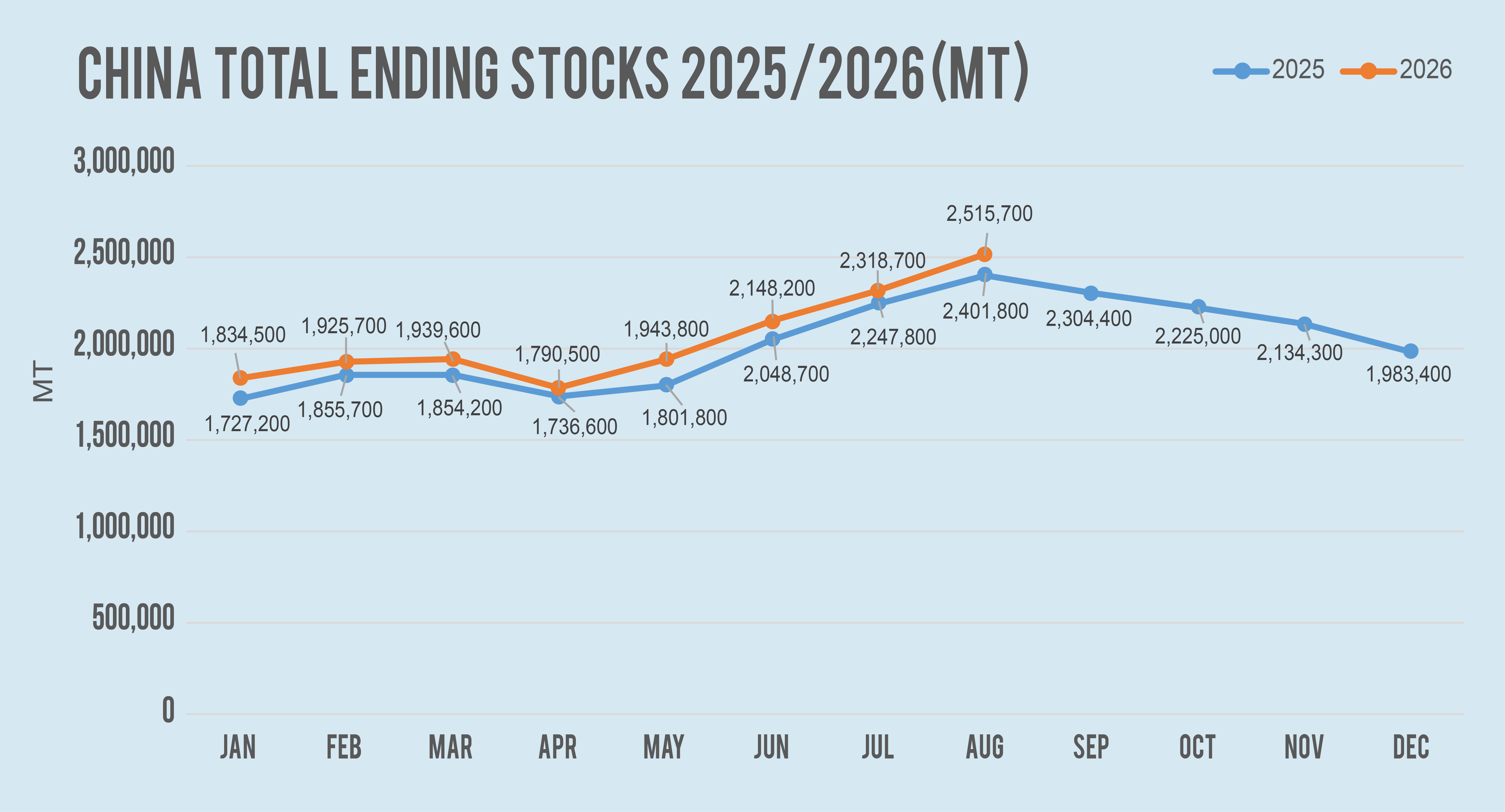
China’s total stocks of the three major vegetable oils-soybean oil (SBO), palm oil (PO), and rapeseed oil (RSO)- totalled 2.52 million metric tonnes (MT) at the end of August 2026, up by 197,000 MT or 8.5% m-o-m and by 113,900 MT or 4.7% y-o-y, continuing to hit a new high. The gain was driven mainly by heavy PO arrivals and sustained high SBO output, while RSO stocks stayed historically low due to supply constraints.
PO stocks reached 873,700 MT at the end of Aug'26, up 2.69% m-o-m and surging 47.8% y-o-y. The accumulation reflected sustained strains from both the supply and demand sides. Heavy arrivals of shipments ordered earlier kept stocks elevated through August, especially after PO imports jumped 56.6% y-o-y to 398,800 MT in Jul'26 and August maintained a strong inflow pace. On the demand side, the price spread between SBO and PO remained deeply inverted and even widened over the month, undermining palm’s competitiveness, and restricting most buyers to essential demand amidst dull trading.
SBO stocks stood at 1.23 million MT at the end of Aug'26, representing a monthly increase of 84,300 MT or 7.4% and a 7.1% gain from a year earlier. Soybean arrivals were estimated to exceed 10 million MT and monthly crushing volumes projected at a similar level in Aug'26, sustaining high SBO production. While stocking ahead of the new school term and Mid‑Autumn Festival provided some support and moderated the pace of stock growth, yet the market was still in its usual off‑season, with most buyers limiting purchases to absolute necessities. However, the growing demand was insufficient to absorb the growing supply, and stocks thus kept building against the backdrop of a persistent supply glut.
RSO stocks across China totalled 414,000 MT, posting a 11.3% m‑o‑m rise but still 37.7% lower than a year ago, holding at low levels. Tighter GMO inspections in Russia curbed its exports to China, and at the same time, domestic crushing remained tepid, restricting new RSO production. Demand stayed lacklustre due to both the off‑season and elevated RSO prices. However, the supply shortfall outweighed the demand weakness, leading to a sustained drawdown in stocks.
Source: MPOC Market Intelligence
*Disclaimer: This document has been prepared based on information from sources believed to be reliable but we do not make any representations as to its accuracy. This document is for information only and opinion expressed may be subject to change without notice and we will not accept any responsibility and shall not be held responsible for any loss or damage arising from or in respect of any use or misuse or reliance on the contents. We reserve our right to delete or edit any information on this site at any time at our absolute discretion without giving any prior notice.
| Country : India | ||||||||||||
|---|---|---|---|---|---|---|---|---|---|---|---|---|
| Oils and Fats Ending Stocks | ||||||||||||
| Palm Oil (MT) | Soybean Oil (MT) | Sunflower Oil (MT) | Rapeseed Oil (MT) | Other Oils (MT) | Total Ending Stocks (MT) | |||||||
| 2026 | 2025 | 2026 | 2025 | 2026 | 2025 | 2026 | 2025 | 2026 | 2025 | 2026 | 2025 | |
| January | 486,000 | 310,000 | 190,000 | 330,000 | 185,000 | 268,000 | 3,000 | - | - | - | 864,000 | 908,000 |
| February | 534,000 | 408,000 | 170,000 | 237,000 | 115,000 | 195,000 | - | - | - | - | 819,000 | 840,000 |
| March | 413,000 | 335,000 | 103,000 | 225,000 | 93,000 | 260,000 | - | - | - | - | 609,000 | 700,000 |
| April | 466,000 | 265,000 | 180,000 | 135,000 | 190,000 | 300,000 | - | - | - | - | 836,000 | 720,000 |
| May | 364,000 | 290,000 | 265,000 | 175,000 | 310,000 | 285,000 | - | - | - | - | 939,000 | 750,000 |
| June | 316,000 | 340,000 | 280,000 | 180,000 | 310,000 | 220,000 | - | - | - | - | 906,000 | 740,000 |
| July | 370,000 | 445,000 | 403,000 | 250,000 | 358,000 | 250,000 | - | - | - | - | 1,131,000 | 945,000 |
| August | 420,000 | 535,000 | 390,000 | 215,000 | 293,000 | 210,000 | - | 6,000 | - | - | 1,103,000 | 966,000 |
| September | 540,000 | 290,000 | 195,000 | 4,000 | - | 1,029,000 | ||||||
| October | 570,000 | 270,000 | 160,000 | 3,000 | - | 1,003,000 | ||||||
| November | 627,000 | 265,000 | 125,000 | 6,000 | - | 1,023,000 | ||||||
| December | 456,000 | 300,000 | 200,000 | 5,000 | - | 961,000 | ||||||
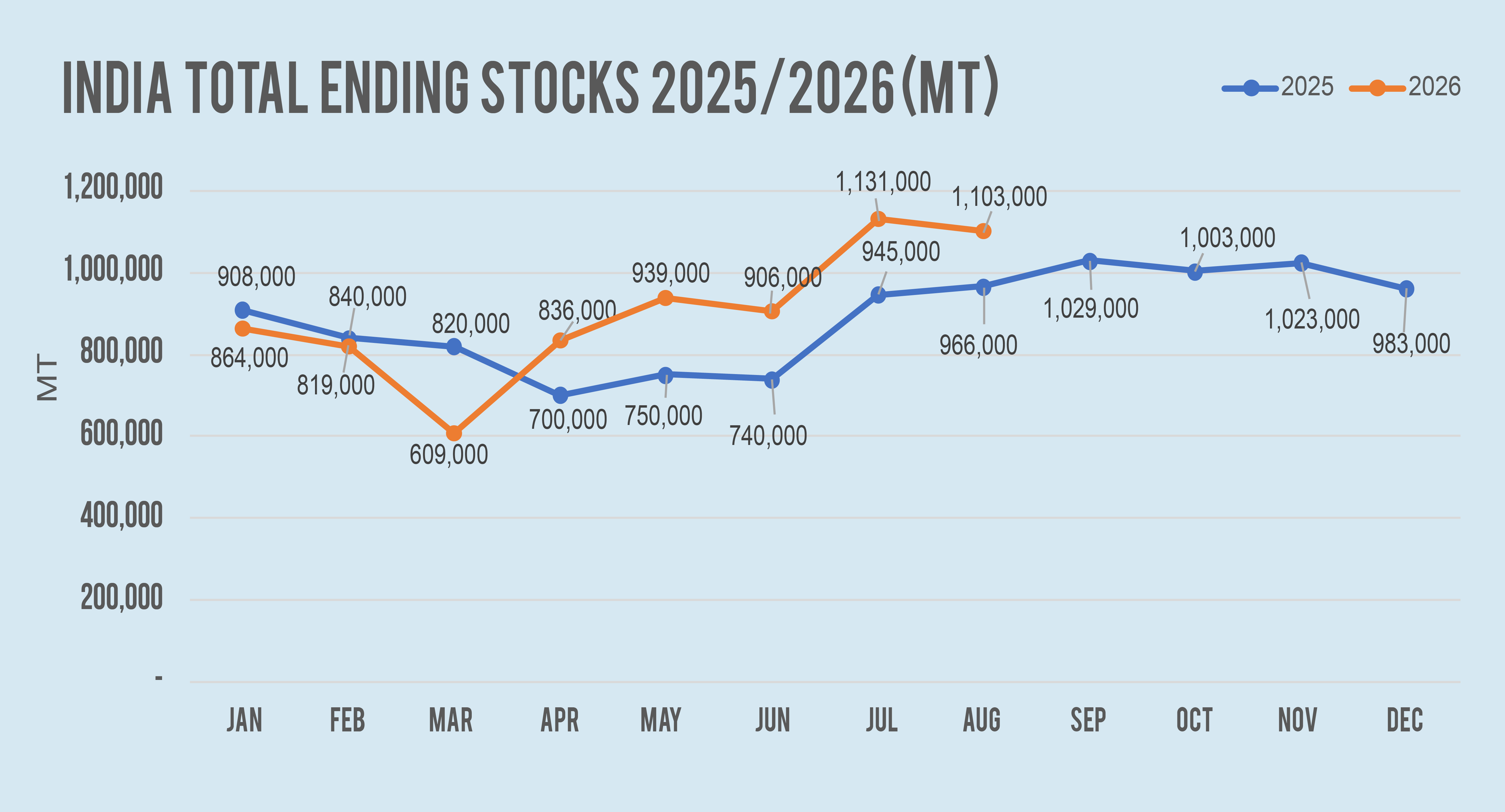
India’s edible oil stocks at ports stood at 1.10 MMT in August 2026, easing 2.5% from 1.13 MMT in July but remaining 14.2% above August 2025. The decline from July was mainly due to lower soft-oil inventories, with sunflower oil stocks falling 18.2% MoM to 293 KMT and soybean oil stocks marginally declining 3.2% to 390 KMT. In contrast, palm oil stocks increased 13.5% MoM to 420 KMT, although they remained 21.5% below the level recorded a year earlier. Soybean and sunflower oil stocks were higher year-on-year by 81.4% and 39.5%, respectively. The comfortable stock position was supported by strong import arrivals during August, with palm oil imports at around 790 KMT, soybean oil at 550 KMT and sunflower oil at 155 KMT. Overall, the August stock position indicates adequate edible oil availability, with the inventory mix shifting towards palm oil. While higher palm oil stocks provide better near-term availability, significantly higher soft-oil inventories mean that palm oil will continue to compete on relative pricing in the coming months.
Source: MPOC Market Intelligence
*Disclaimer: This document has been prepared based on information from sources believed to be reliable but we do not make any representations as to its accuracy. This document is for information only and opinion expressed may be subject to change without notice and we will not accept any responsibility and shall not be held responsible for any loss or damage arising from or in respect of any use or misuse or reliance on the contents. We reserve our right to delete or edit any information on this site at any time at our absolute discretion without giving any prior notice.
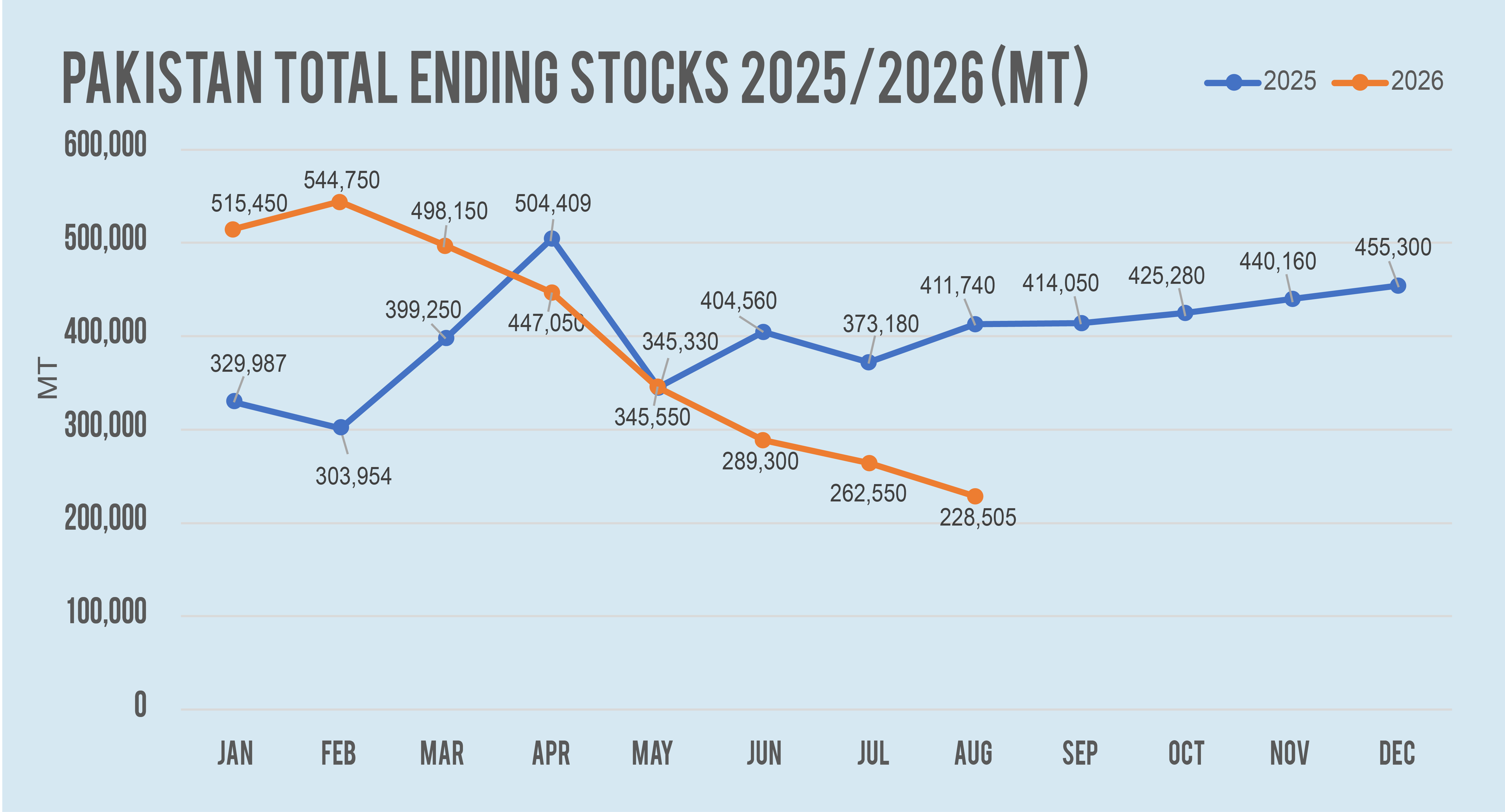
Edible oil stocks at Port Qasim Authority (PQA) and Karachi Port Trust (KPT) declined further to 228,505 MT at the end of August 2026, down 13.0% month-on-month and 44.5% year-on-year. Inventories have remained on a sustained downward trend since February, marking six consecutive months of stock drawdowns. The continued decline is consistent with the ongoing unwinding of the stock overhang accumulated during the period of exceptionally high imports in late 2025 and early 2026, as importers continue to draw on existing inventories while maintaining a more cautious approach to fresh purchases.
Edible oil imports eased marginally to 239,757 MT in August, down 3.7% from 249,012 MT in July. While import volumes remained relatively firm, arrivals were still insufficient to offset inventory withdrawals during the month, resulting in a further reduction in port stocks. This suggests that the earlier inventory adjustment has yet to fully run its course, with stock levels continuing to be worked down following the previous period of excess supply.
Of the total ending stocks, RBD palm olein accounted for the largest share at 53.3%, followed by RBD palm oil at 42.5%. Palm oil and its fractions represented the entire reported inventory, reaffirming palm oil’s dominant position in Pakistan’s edible oil supply.
Source: MPOC Market Intelligence
*Disclaimer: This document has been prepared based on information from sources believed to be reliable but we do not make any representations as to its accuracy. This document is for information only and opinion expressed may be subject to change without notice and we will not accept any responsibility and shall not be held responsible for any loss or damage arising from or in respect of any use or misuse or reliance on the contents. We reserve our right to delete or edit any information on this site at any time at our absolute discretion without giving any prior notice.
| Country : Bangladesh | ||||||||||||
|---|---|---|---|---|---|---|---|---|---|---|---|---|
| Oils and Fats Ending Stocks | ||||||||||||
| Palm Oil (MT) | Soybean Oil (MT) | Sunflower Oil (MT) | Rapeseed Oil (MT) | Other Oils (MT) | Total Ending Stocks (MT) | |||||||
| 2026 | 2025 | 2026 | 2025 | 2026 | 2025 | 2026 | 2025 | 2026 | 2025 | 2026 | 2025 | |
| January | 115,950 | 67,100 | 45,042 | 15,740 | - | - | - | - | - | - | 160,992 | 82,840 |
| February | 111,150 | 118,750 | 24,952 | 40,900 | - | - | - | - | - | - | 136,102 | 159,650 |
| March | 99,460 | 89,510 | 4,656 | 45,030 | - | - | - | - | - | - | 104,116 | 134,540 |
| April | 71,950 | 78,500 | 7,764 | 57,710 | - | - | - | - | - | - | 79,714 | 136,210 |
| May | 72,250 | 52,400 | 11,324 | 72,400 | - | - | - | - | - | - | 83,574 | 124,800 |
| June | 33,780 | 68,720 | 7,180 | 46,450 | - | - | - | - | - | - | 40,960 | 115,170 |
| July | 58,030 | 90,330 | 16,710 | 39,010 | - | - | - | - | - | - | 74,740 | 129,340 |
| August | 64,000 | 81,900 | 36,880 | 36,500 | - | - | - | - | - | - | 100,880 | 118,400 |
| September | 97,650 | 7,100 | - | - | - | 104,750 | ||||||
| October | 109,860 | 32,800 | - | - | - | 142,660 | ||||||
| November | 90,560 | 44,240 | - | - | - | 134,800 | ||||||
| December | 111,760 | 16,110 | - | - | - | 127,870 | ||||||
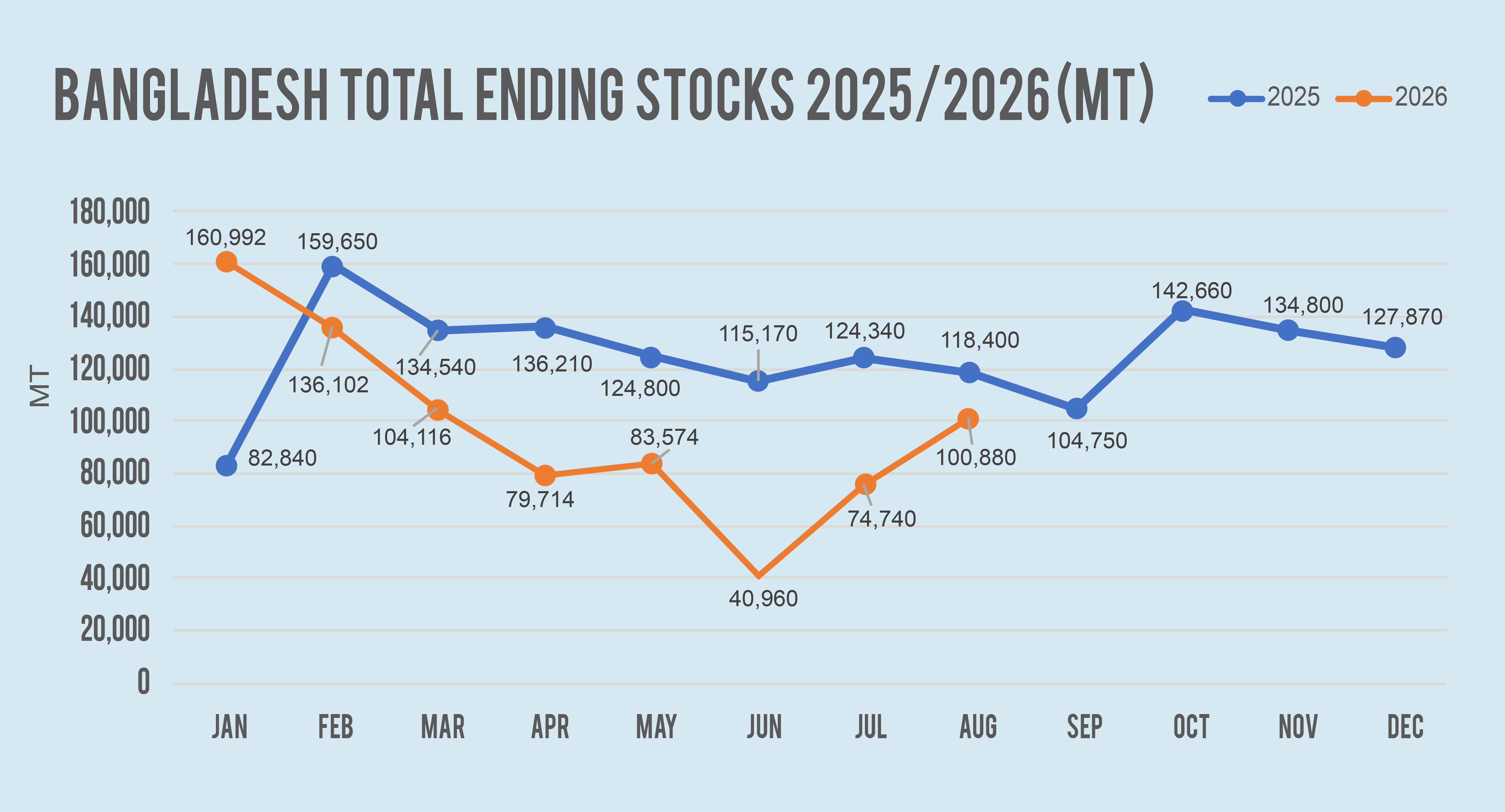
In August 2026, Bangladesh’s total edible oil ending stocks increased to 100,880 MT, up 34.97% month-on-month from 74,740 MT in July. The increase indicates that the market continued to rebuild inventories following the sharp stock drawdown recorded in June. Despite the recovery, total stocks remained 14.80% below August 2025, showing that inventory levels were still below those of a year earlier. Palm oil stocks increased by 10.29% month-on-month to 64,000 MT but remained 21.85% lower year-on-year. Palm oil continued to account for the largest share of total edible oil stocks at around 63%, maintaining its importance in Bangladesh’s near-term supply position. Soybean oil stocks recorded a much stronger recovery, rising 120.70% month-on-month to 36,880 MT. Unlike palm oil, soybean oil stocks were slightly higher than August 2025, by around 1.04%, indicating a significant improvement in availability compared with the tight stock position seen earlier in the year.
Overall, August shows a clear improvement in Bangladesh’s inventory position, with total stocks recovering for the second consecutive month. However, inventories remained below last year’s level, particularly for palm oil, suggesting that the market has rebuilt part of its buffer but has not yet returned to the more comfortable stock levels seen in 2025.
Source: MPOC Market Intelligence
*Disclaimer: This document has been prepared based on information from sources believed to be reliable but we do not make any representations as to its accuracy. This document is for information only and opinion expressed may be subject to change without notice and we will not accept any responsibility and shall not be held responsible for any loss or damage arising from or in respect of any use or misuse or reliance on the contents. We reserve our right to delete or edit any information on this site at any time at our absolute discretion without giving any prior notice.
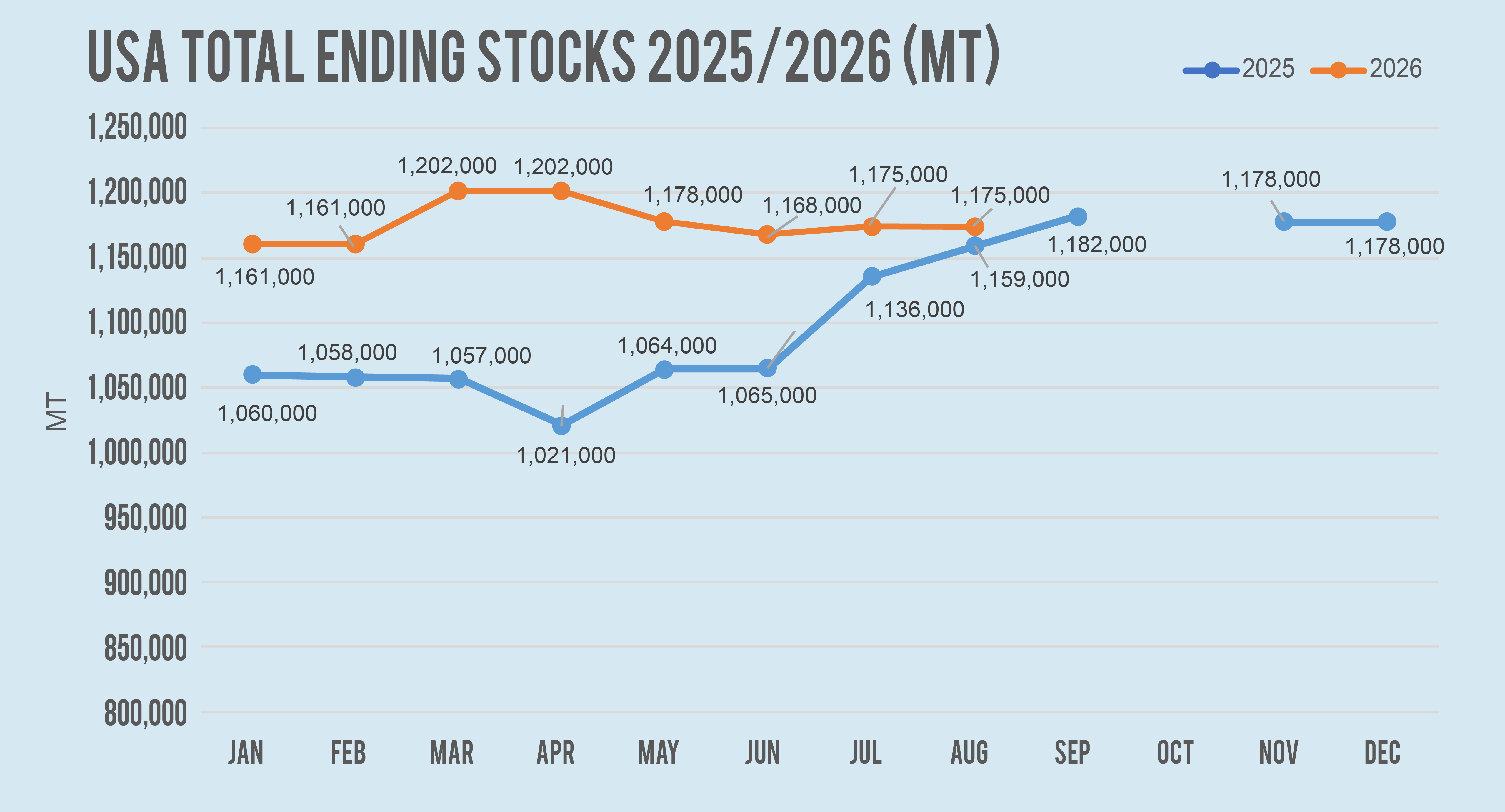
| Country : USA | ||||||||||||
|---|---|---|---|---|---|---|---|---|---|---|---|---|
| Oils and Fats Ending Stocks | ||||||||||||
| Palm Oil (MT) | Soybean Oil (MT)* | Sunflower Oil (MT)* | Rapeseed Oil (MT) | Other Oils (MT) | Total Ending Stocks (MT)* | |||||||
| 2026 | 2025 | 2026 | 2025 | 2026 | 2025 | 2026 | 2025 | 2026 | 2025 | 2026 | 2025 | |
| January | 159,000 | 159,000 | 795,000 | 694,000 | 29,000 | 26,000 | 57,000 | 55,000 | 121,000 | 126,000 | 1,161,000 | 1,060,000 |
| February | 159,000 | 159,000 | 795,000 | 694,000 | 29,000 | 23,000 | 57,000 | 56,000 | 121,000 | 126,000 | 1,161,000 | 1,058,000 |
| March | 159,000 | 159,000 | 836,000 | 694,000 | 29,000 | 23,000 | 57,000 | 55,000 | 121,000 | 126,000 | 1,202,000 | 1,057,000 |
| April | 159,000 | 159,000 | 836,000 | 658,000 | 29,000 | 23,000 | 57,000 | 55,000 | 121,000 | 126,000 | 1,202,000 | 1,021,000 |
| May | 136,000 | 159,000 | 860,000 | 694,000 | 27,000 | 29,000 | 67,000 | 56,000 | 88,000 | 126,000 | 1,178,000 | 1,064,000 |
| June | 136,000 | 159,000 | 851,000 | 694,000 | 27,000 | 29,000 | 66,000 | 57,000 | 88,000 | 126,000 | 1,168,000 | 1,065,000 |
| July | 136,000 | 159,000 | 851,000 | 758,000 | 27,000 | 29,000 | 73,000 | 64,000 | 88,000 | 126,000 | 1,175,000 | 1,136,000 |
| August | 136,000 | 159,000 | 851,000 | 781,000 | 27,000 | 29,000 | 73,000 | 64,000 | 88,000 | 126,000 | 1,175,000 | 1,159,000 |
| September | 159,000 | 787,000 | 29,000 | 81,000 | 126,000 | 1,182,000 | ||||||
| October | N/A | N/A | N/A | N/A | N/A | N/A | ||||||
| November | 159,000 | 783,000 | 29,000 | 81,000 | 126,000 | 1,178,000 | ||||||
| December | 159,000 | 783,000 | 29,000 | 81,000 | 126,000 | 1,178,000 | ||||||
As of August 2026, U.S. ending stocks stood at 1.175 million MT, unchanged from the previous month. Ending stocks for palm oil, soybean oil, sunflower oil, and rapeseed oil also remained unchanged from the previous month. Argentina’s soybean crushing remains strong, supporting ample supplies of soybean oil and meal. Direct soybean exports have weakened as more soybeans are processed domestically, supplemented by imports from neighbouring countries such as Paraguay. Soybean oil exports remain relatively high, particularly to India and Nepal, while domestic biodiesel demand is also increasing. Argentina’s sunflowerseed crushing and sunflower oil exports have also strengthened, adding further competition to the global vegetable oil market. Seasonal declines in South American soybean crushing, however, could reduce export availability later in the year, potentially providing some support for palm oil demand.
Brazil’s soybean exports reached a record 83 million tonnes, while crushing also remained strong, supported by favourable margins and robust demand for soybean oil and meal. Soybean oil exports have doubled from the previous month, driven mainly by strong demand from India. At the same time, domestic soybean oil use for biodiesel is increasing, with Brazil’s biodiesel production reaching a record 806,000 tonnes in July 2026 following the increase in the mandatory blending rate from 14% to 15%. Brazil’s ample soybean and soybean oil supplies therefore remain a key source of competition for other vegetable oils, particularly in price-sensitive markets.
The U.S. oils and fats market is tightening because biofuel demand is growing faster than domestic feedstock supply. Record soybean crushing has not been enough to prevent soybean oil stocks from falling, while the U.S. is increasingly relying on imported canola oil, palm oil, UCO, tallow and even soybean oil. At the same time, stronger Chinese soybean buying and weaker crop conditions are raising the risk of a tighter U.S. soybean balance.
Source: *USDA, MPOC Estimates
*Disclaimer: This document has been prepared based on information from sources believed to be reliable but we do not make any representations as to its accuracy. This document is for information only and opinion expressed may be subject to change without notice and we will not accept any responsibility and shall not be held responsible for any loss or damage arising from or in respect of any use or misuse or reliance on the contents. We reserve our right to delete or edit any information on this site at any time at our absolute discretion without giving any prior notice.