

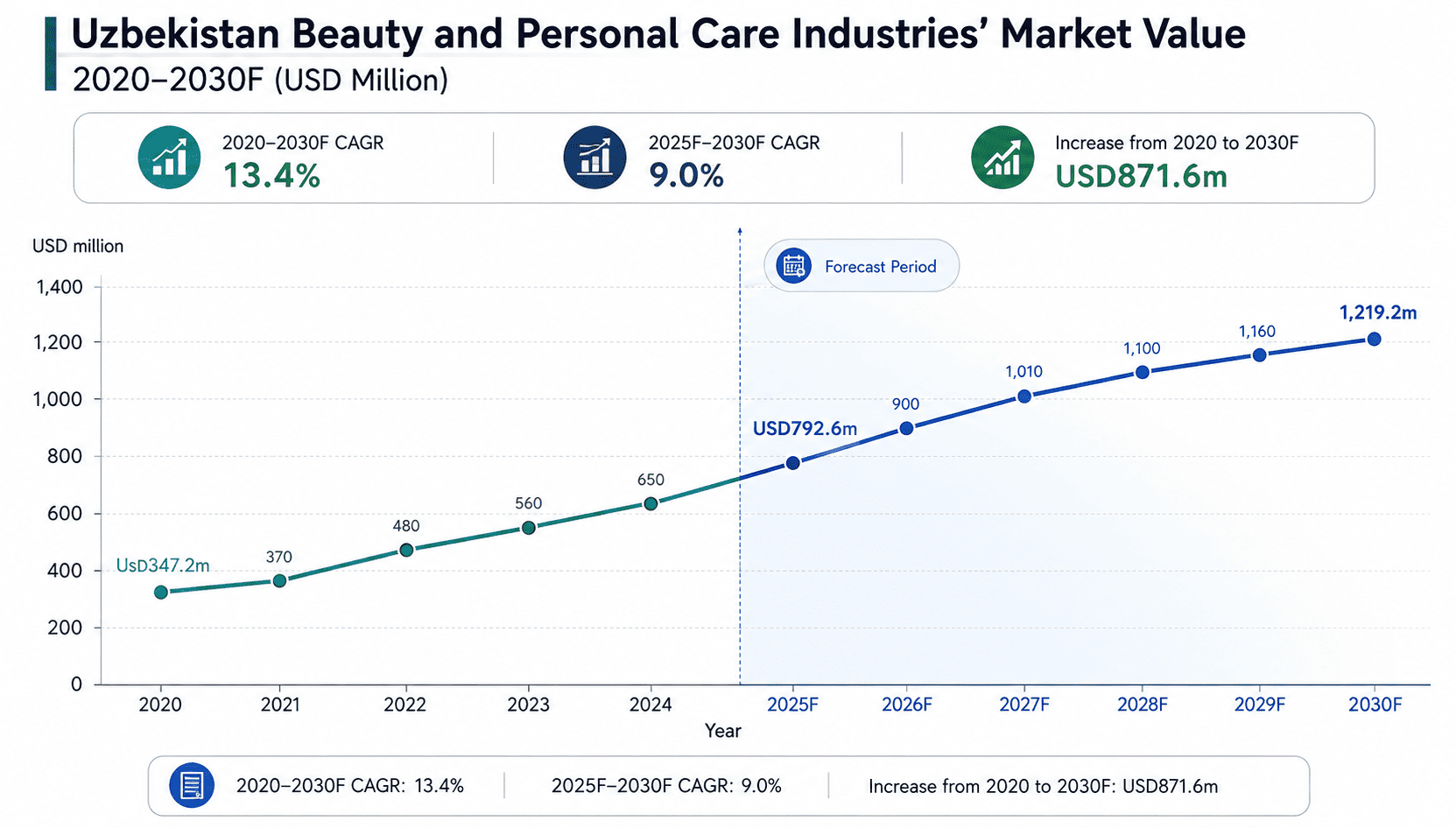
Uzbekistan is emerging as one of Central Asia’s more attractive consumer markets, with beauty and personal care becoming an important part of this transition. Once driven mainly by basic hygiene needs, the market is now moving towards more sophisticated consumption, supported by rising incomes, urban lifestyles, digital influence and growing interest in health, grooming and self-care. Based on selected beauty and personal care categories, market value increased from USD651.4 million in 2024 to USD792.6 million in 2025, representing growth of around 21.7%. By 2030, the market is projected to reach USD1.22 billion, reflecting a CAGR of around 9.0% from 2025 to 2030. This steady expansion points to growing demand for value-added ingredients used in beauty, personal care and hygiene products.
Source: Euromonitor International, 2026
For Malaysian palm oil industry players, this shift is increasingly relevant. Beauty and personal care products depend heavily on functional ingredients, including palm-based oleochemicals used in soaps, shampoos, cosmetics, skincare, toiletries and hygiene products. As Uzbek consumers become more ingredient-aware and product-savvy, the market offers potential for higher-value palm-based derivatives beyond traditional commodity applications.
Growth is being driven by a young and increasingly urban consumer base. In cities such as Tashkent, beauty routines are no longer limited to basic cleansing. Consumers are adopting structured skincare, hair care and grooming habits shaped by social media, Korean beauty trends, influencer recommendations and wider access to modern retail channels. Beauty specialist stores such as Bloom, EvoEva and M Cosmetics, together with online platforms such as Uzum and Wildberries, are making it easier for consumers to discover both mass-market and premium products. While affordability remains important, consumers are showing stronger interest in products that combine value, effective formulation, attractive packaging and visible benefits.
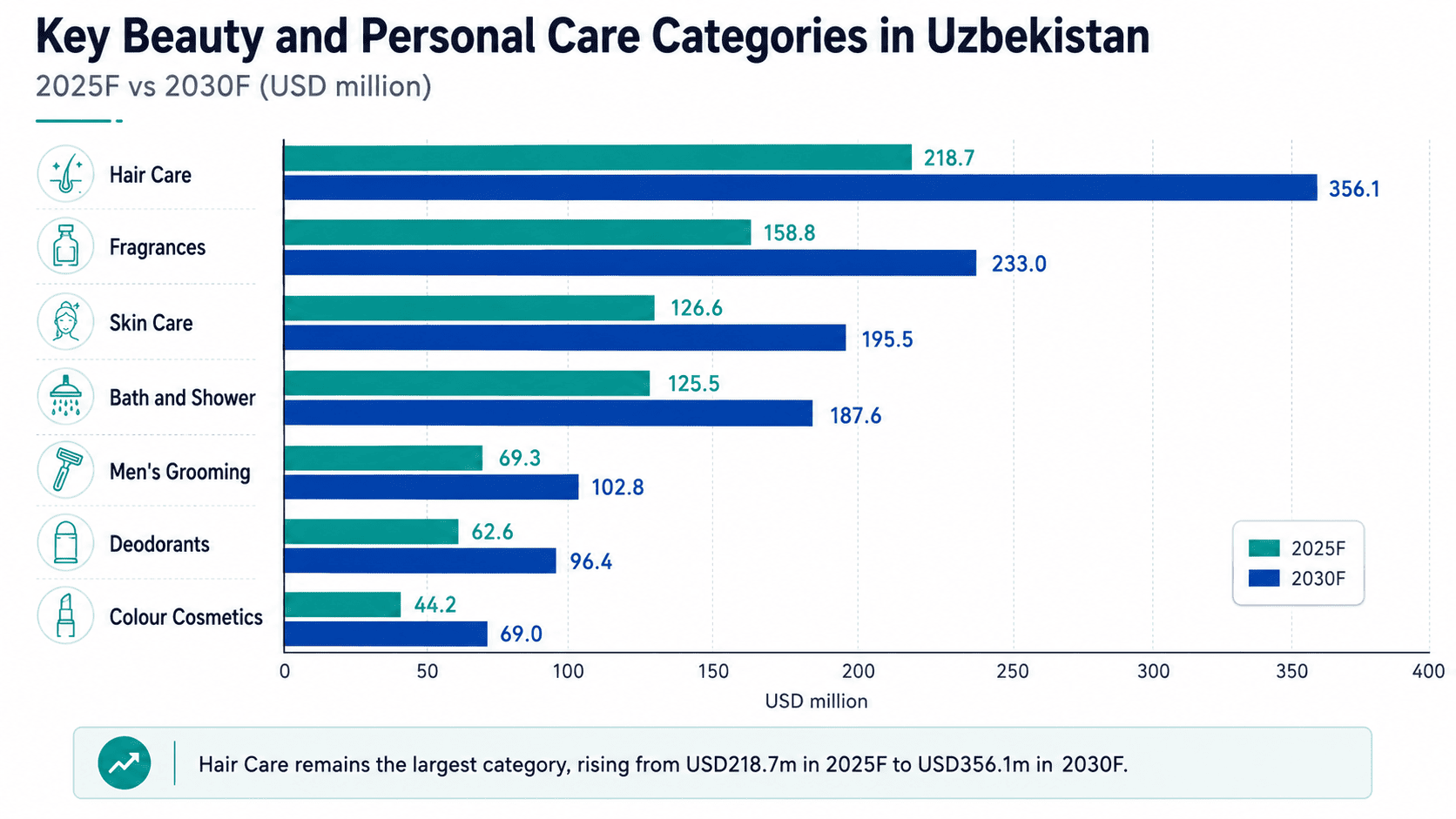
The market is concentrated around four major categories: hair care, fragrances, skin care, and bath and shower products. In 2025, these categories generated combined sales of around USD629.6 million, accounting for about 79.4% of the selected beauty and personal care market. By 2030, their combined value is projected to reach approximately USD972.2 million, representing around 79.8% of total sales. This indicates that the core demand base will remain anchored in daily-use personal care and beauty essentials, even as categories such as men’s grooming, deodorants and colour cosmetics continue to expand.
Source: Euromonitor International, 2026
Hair care is the largest category, valued at USD218.7 million in 2025 and projected to reach USD356.1 million by 2030. Growth is supported by demand for shampoos, conditioners, treatments and scalp-care products offering benefits such as hydration, anti-dandruff protection and hair strengthening. Fragrances, valued at USD158.8 million in 2025, are expected to increase to USD233.0 million by 2030, supported by the cultural importance of scent as part of personal identity and daily presentation. Skin care is also gaining momentum, rising from USD126.6 million to USD195.5 million, driven by urban consumers seeking moisturisers, serums, anti-ageing products and science-backed formulations. Bath and shower products are projected to grow from USD125.5 million to USD187.6 million, with bar soap remaining important while liquid soap, shower gels and wellness-oriented bath products gain traction.
Several trends are reshaping the industry. Consumers are shifting towards multifunctional products that combine cleansing, moisturising, protection and visible benefits in one formulation. Science-led beauty is also becoming more influential, particularly products featuring ingredients such as vitamin C, niacinamide, hyaluronic acid and plant extracts. At the same time, Korean beauty is raising expectations through lightweight textures, minimalist packaging, gentle formulations and strong digital appeal. Clean beauty, vegan claims, cruelty-free positioning and sustainability are also becoming more visible, especially among younger urban consumers. These trends create demand for ingredients that support mildness, foaming, emulsification, texture, stability and moisturising performance.
From a Malaysian palm oil export perspective, Uzbekistan remains a relatively small market, but its expanding beauty and personal care industry is increasingly relevant to Malaysia’s downstream palm oil sector. In 2025, Malaysia exported 28,498 MT of palm oil and palm-based products to Uzbekistan, compared with 37,863 MT in 2024. The export basket comprised palm oil products, mainly processed palm oil, at 10,610 MT, followed by finished products at 9,197 MT, palm-based oleochemicals at 5,233 MT and palm kernel oil at 3,458 MT. While overall export volume declined year-on-year, the increase in finished products and palm-based oleochemicals indicates potential demand for palm-based inputs used in beauty, personal care, hygiene and industrial formulations.
As Uzbekistan’s consumer market develops, the country presents a strategic opportunity for Malaysia to expand the presence of higher-value palm-based ingredients in Central Asia’s beauty, personal care and hygiene sectors. Malaysian companies are well placed to supply palm-based oleochemicals, emulsifiers, surfactants, glycerine, fatty acids, fatty alcohols and other derivatives used in cosmetics and toiletries. Strengthening technical promotion, market engagement and partnerships with formulators, distributors and personal care manufacturers will be key to realising this potential. By positioning palm-based ingredients as reliable, versatile and sustainable solutions, Malaysia can support Uzbekistan’s evolving personal care industry while creating new avenues for value-added palm oil exports.
Prepared by Ms. Azriyah Azian